Increasing an advertising budget can help a successful campaign reach more people, but spending more does not automatically produce better results. Before allocating additional money to digital advertising, businesses should understand how their existing campaigns perform, where potential problems exist, and whether the available data supports expansion.
A simple campaign audit can help marketing teams make more informed budget decisions while reducing the risk of scaling an underperforming strategy.
1. Review the Original Campaign Objective
Start by identifying what the campaign was designed to achieve. A campaign focused on brand awareness will have different success criteria from one designed to generate leads or online sales.
Common objectives include:
Increasing qualified website traffic
Generating enquiries and leads
Improving online sales
Reducing customer acquisition costs
Increasing brand awareness among a specific audience
Compare actual results with the original objective. This prevents decisions from being driven by surface-level metrics that may not reflect business success.
2. Check Whether the Tracking Is Reliable
Before interpreting performance reports, verify that the underlying data is accurate.
Check whether conversion events are configured correctly, duplicate conversions are being avoided, and important actions are recorded consistently. Where possible, compare advertising platform reports with website analytics or customer relationship management records.
Differences between reporting systems are common because platforms may use different attribution models, conversion windows, and counting methods.
If tracking is incomplete, increasing the budget based on unreliable figures could lead to poor decisions.
3. Evaluate the Most Relevant Metrics
Different metrics reveal different aspects of campaign performance. Reviewing them together provides a more balanced picture.
Click-through rate (CTR): Indicates how often people click after seeing an advertisement. A change in CTR may reflect differences in creative quality, audience relevance, or placement.
Cost per click (CPC): Shows the average cost of generating a click. A lower CPC is not necessarily better if the traffic does not convert.
Conversion rate: Helps measure how effectively clicks or visits lead to a desired action.
Cost per acquisition (CPA): Shows the average advertising cost associated with acquiring a conversion or customer, depending on how acquisition is defined.
Return on ad spend (ROAS): Compares attributed revenue with advertising expenditure. Profit margins and other operating costs must also be considered when assessing profitability.
The most useful metrics are those that directly support the campaign's business objectives.
4. Identify Where Performance Is Breaking Down
A campaign should be evaluated as a complete customer journey, from the initial advertisement to the final conversion.
For example, a campaign may attract plenty of clicks but generate very few enquiries. Possible explanations include a mismatch between the advertisement and landing page, an unclear offer, a complicated form, or an audience that is not ready to purchase.
Alternatively, a campaign may convert visitors effectively but have limited reach. In that situation, carefully expanding the audience could be worth testing.
These are hypotheses, not automatic conclusions. Review the available evidence before deciding what to change.
5. Segment Results Before Making Changes
Overall campaign averages can conceal important differences. Break down performance using relevant dimensions such as audience, creative, device, location, advertising platform, and time period.
Segmentation can help answer questions such as:
Which audience groups generate the most qualified leads?
Are some creative variations consistently outperforming others?
Does performance differ significantly between mobile and desktop visitors?
Are conversion costs changing over time?
Do particular campaigns generate revenue but struggle with profitability?
Avoid drawing strong conclusions from small samples or short periods of unusual performance. Seasonality and changes in targeting can also affect results.
6. Use Analytical Tools to Organize the Findings
Reviewing multiple campaigns manually can make it difficult to spot patterns and compare results consistently. Reporting dashboards and analytical tools can help organize the information into a more understandable format.
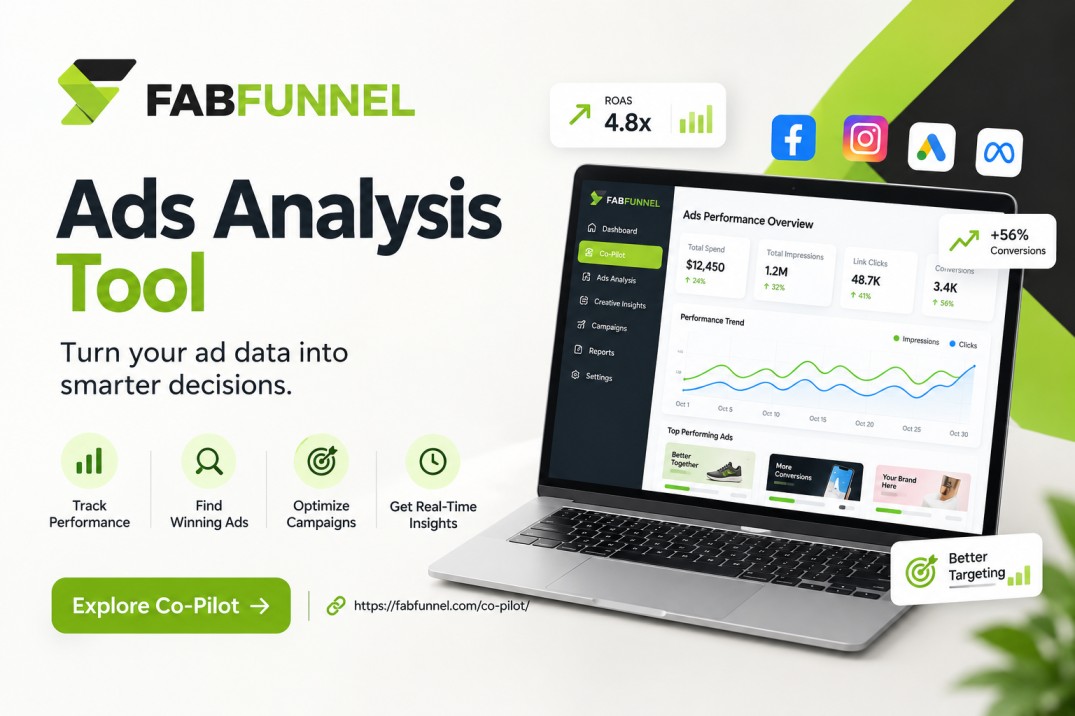
An ads analysis tool can be useful when marketers need support interpreting advertising data and reviewing performance insights. FabFunnel Co-Pilot is one option for exploring AI-powered advertising analysis, including insights, charts, tables, and recommendations.
The value of any tool depends on the quality of the available data and how well its outputs address the questions being investigated. AI-generated recommendations should be checked against actual campaign results rather than accepted without review.
7. Decide Whether the Campaign Is Ready to Scale
Once the audit is complete, consider whether the campaign has demonstrated sufficiently consistent performance to justify additional investment.
Before increasing spending, ask:
Is tracking reliable enough to support the decision?
Are conversions relevant to the business objective?
Is performance reasonably consistent across the evaluation period?
Can the business handle the additional leads or orders?
Are acquisition costs sustainable relative to customer value and margins?
Is there evidence that the campaign can expand without substantially reducing efficiency?
If the answers are unclear, a controlled budget increase may provide more useful information than a large, immediate change.
8. Monitor the Results After Increasing the Budget
Campaign performance can change as spending increases. Audience saturation, competition, and differences in traffic quality may affect the results.
After making a budget adjustment, monitor the primary success metric alongside supporting indicators. Record the change, its date, and the outcome so that future decisions can be based on a clear history of experiments.
Avoid changing several major campaign variables simultaneously unless there is a specific reason to do so. Making controlled adjustments helps teams understand which changes are associated with the observed results.
Conclusion
A campaign audit provides a structured way to evaluate advertising performance before committing additional resources. By checking tracking accuracy, reviewing relevant metrics, investigating weak points, and comparing results across segments, businesses can make more informed decisions about their advertising budgets.
Analytical tools can make this process easier, but good decisions still depend on reliable data, clear objectives, and careful interpretation. The goal is not simply to spend more on advertising; it is to understand which investments are most likely to support sustainable business growth.