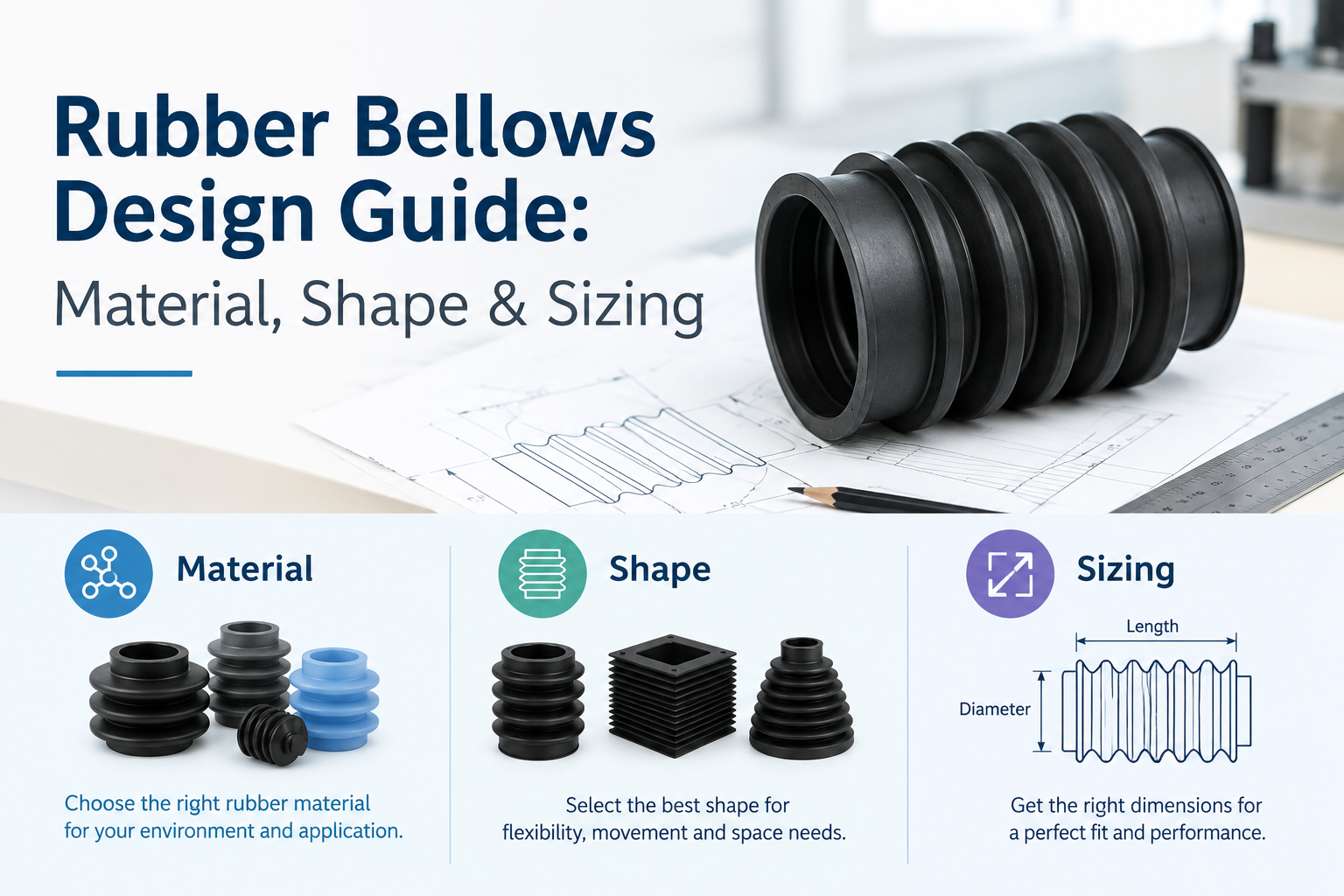
A rubber bellows looks like a simple part. It is a flexible, pleated sleeve that covers a moving joint, shaft or rod. But it does a lot of quiet work. It keeps dust, water and chemicals out, holds lubricant in, and absorbs movement and vibration so the parts inside last longer.
When a bellows fails early, the cause is rarely bad rubber. It is usually a design that didn't match the real working conditions. This guide walks through the three decisions that matter most in rubber bellows design: material, shape and sizing. It also covers the mistakes we see most often.
Start with the application, not the drawing
Before you pick a material or sketch a shape, answer these questions:
What movement does the bellows handle? Axial (push and pull), angular (bending), lateral (side to side) or a mix.
What is the temperature range? Include the peaks, not just the average.
What will it touch? Oil, fuel, coolant, steam, cleaning chemicals, ozone, UV or salt spray.
How often does it move? A bellows that flexes once a day has a different life from one that flexes thousands of times an hour.
Is there pressure or vacuum inside?
For example, a bellows on a CNC machine way cover sees cutting oil and metal chips. A bellows on a marine steering system sees salt water and sunlight. Both are "rubber bellows," but they need very different designs.
Choosing the right material
Material is the most important decision in rubber bellows design. Here is how the common options compare:
EPDM: Excellent against weather, ozone, water and steam. Poor with petroleum oils and fuels. A good choice for outdoor, plumbing and HVAC use.
Neoprene (CR): A balanced all-rounder. It handles moderate oil exposure, weather and flexing, which is why it is popular in general industrial and automotive parts.
Nitrile (NBR): Strong resistance to oils and fuels. It does not like ozone and long sun exposure.
Silicone: Works across a very wide temperature range, stays flexible in the cold and can be made food-grade, medical-grade or even transparent. It has lower tear strength, so it suits cleaner, lighter-duty jobs.
Fluoroelastomer (FKM/Viton): Best for high heat and aggressive chemicals. It costs more, so use it where cheaper rubbers will not survive.
A simple rule: match the material to the worst thing it will meet, not the most common thing. A bellows that sees 95% clean air but occasional hot oil still needs oil-resistant rubber.
Hardness matters too. Most bellows are made between 40 and 70 Shore A. Softer rubber flexes more easily but can balloon under pressure. Harder rubber holds its shape but resists movement.
Shape: let the space and the movement decide
Shape is not just about looks. It controls how the bellows folds, how it fits and how stress spreads through the rubber.
Round (circular) bellows are the most common. Stress is spread evenly, so they are usually the most durable option for rotating or telescoping parts.
Square and rectangular bellows suit linear guides, slides and machine covers where the space is flat-sided. Corners need generous radii, because sharp corners are where cracks begin.
Hexagonal and C-type bellows are used when space is tight or the part has an unusual profile.
Tapered or stepped bellows handle shafts with different diameters at each end, such as steering racks.
If you have a choice, go with the simplest shape that fits. Complex shapes cost more in tooling and tend to concentrate stress.
Sizing: convolutions, stroke and wall thickness
Sizing is where many designs go wrong. A bellows has to extend and compress without over-stretching or bunching up.
Convolutions are the folds. More convolutions give you more stroke in the same diameter, but a longer part. Fewer convolutions make a stiffer, shorter bellows. A common practice is to design for the full working stroke plus a safety margin, so the rubber is never pulled to its absolute limit.
Wall thickness is a trade-off. Thin walls flex easily and last longer in fatigue, but they puncture more easily. Thick walls resist cuts but can crack at the folds if they flex often.
End connections deserve attention too. Clamp grooves, flanges and sealing beads must grip firmly without pinching the rubber. A bellows that slips off its collar is a design failure, even if the rubber is perfect.
A practical tip: measure the real stroke on the actual machine, with tolerances and wear included. Drawings often show nominal movement, and real equipment moves more.
Common rubber bellows design mistakes
Choosing material by price alone. A cheaper rubber that fails in six months costs more than the right one.
Ignoring temperature spikes. Brief exposure to heat can harden rubber and cause cracking later.
Skipping the prototype. Testing a few sample pieces on the real machine catches problems before full production.
Sharp internal corners. Rubber tears from stress points. Always specify radii.
No allowance for installation. If the bellows is hard to fit, it will get stretched, twisted or damaged during assembly.
How to choose a rubber bellows manufacturer
Not every rubber bellows manufacturer works the same way. A catalogue supplier sells you what is on the shelf. A custom bellows manufacturer designs and builds a part around your equipment. That is worth the effort when standard sizes do not fit or your conditions are demanding.
When comparing rubber bellows suppliers, look for:
Engineering support. Will they advise on material and design, or just quote a price?
In-house tooling. This usually means faster changes and lower tooling costs.
Low minimum order quantities. Useful for prototypes and small runs.
Testing and inspection. Ask how parts are checked for dimensions and performance.
Clear communication. You should know where your project stands at each stage.
What to send when requesting a quote
You will get a faster, more accurate quote if you share:
A drawing, sketch or sample part
Operating temperature range
Stroke and movement type
Media the bellows will touch
Quantity and expected annual volume
Any standards or certifications required
FAQs
How long does a rubber bellows last?
It depends on material, movement frequency and environment. A well-matched bellows can last for years, while a poor match may fail within months.
Can one bellows design work for different machines?
Sometimes, but only if movement, temperature and media are similar. Different conditions usually need a different material or convolution count.
Is a custom design more expensive than a standard one?
There is a one-time tooling cost, but a properly fitted custom part often lasts longer and prevents downtime, which can lower the total cost.
Final thoughts
Good rubber bellows design is about matching the part to the real world: the movement, the heat, the chemicals and the space. Get the material, shape and sizing right, and a bellows can protect your equipment for years with no attention at all.
If you are planning a new project or replacing a part that keeps failing, talk to an experienced custom bellows manufacturer early. A short conversation about your application can save you a long list of problems later.