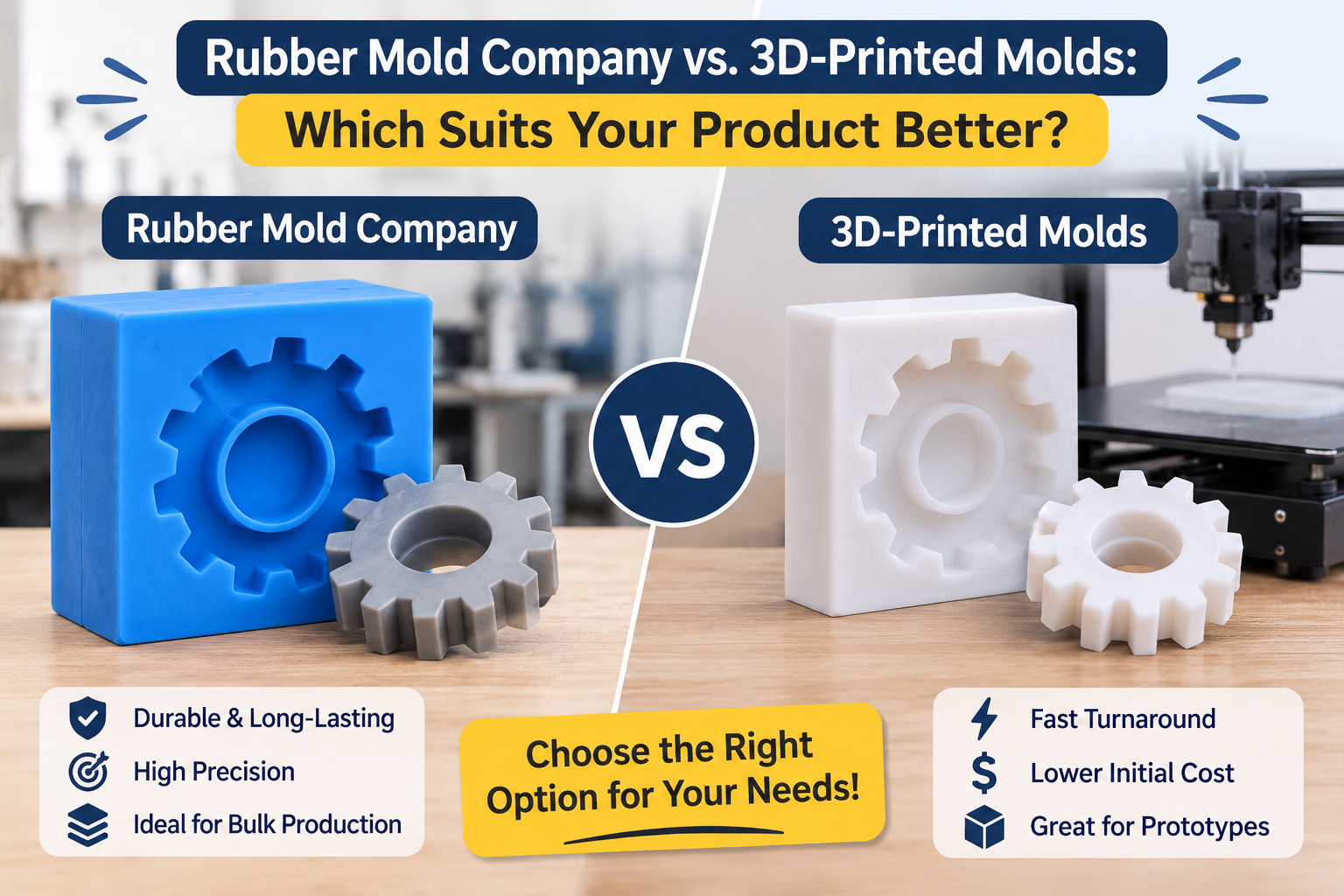
You have a product idea and you need a mold. Should you work with a rubber mold company, or print the mold yourself on a 3D printer? Both options are popular, and both can work well. The right choice depends on how many parts you need, what material you are casting, and how long the mold must last.
This guide explains the real differences in plain language. By the end, you will know which option fits your product, your budget, and your timeline.
What Does a Rubber Mold Company Do?
A rubber mold company designs and makes molds from flexible materials such as silicone and other rubber compounds. You share a master model, a drawing, or a sample, and the team builds a mold that copies every detail of it.
A good rubber mold manufacturer usually handles:
Reviewing your design and suggesting changes that make it easier to mold
Choosing the right rubber or silicone for your product
Building the mold and testing it with sample parts
Supplying finished molds in small or large quantities
Because this is their daily work, a rubber mold company knows which materials last longer, which shapes cause tearing, and how to avoid common problems like air bubbles. That experience is a big part of what you pay for.
What Are 3D-Printed Molds?
3D-printed molds are made by printing a mold shape layer by layer, usually from resin or plastic. Some people print a rigid mold directly. Others print a master model and then pour silicone around it to make a flexible mold.
The big advantage is speed and freedom. You can design a shape on your computer and hold a physical mold in a day or two. That is why designers, hobbyists, and startups often use 3D printing in the early stages of a project.
The weak point is that printed molds are usually rigid and slightly rough on the surface. Flexible molds are better for pulling out parts with curves or undercuts, and that is where rubber molds are strong.
Rubber Mold Company vs. 3D-Printed Molds: The Key Differences
1. Durability
Rubber and silicone molds are built to be used again and again. A well-made mold can produce many parts before it shows wear. Printed molds can crack, warp, or lose detail faster, especially if you cast hot materials or demold often.
If you plan to make parts regularly, custom rubber molds from a professional source are usually the safer choice.
2. Surface Finish and Detail
A rubber mold copies a master model very closely, including fine textures and sharp edges. A 3D-printed mold can show visible layer lines, and those lines transfer to your finished product. You can sand and coat the mold to improve it, but that takes extra time.
For products where looks matter, such as jewelry, soap, candles, resin art, or chocolate, a smooth finish is a major advantage.
3. Flexibility and Easy Demolding
Silicone and rubber bend, so you can peel the mold away from the part without damage. This is very helpful for shapes with hooks, grooves, or hollow areas. A rigid printed mold often has to be split into several pieces, which can leave seam lines on your product.
4. Speed
3D printing is faster at the start. If you need one test mold by tomorrow, printing wins. However, when a rubber mold company already has your design details, the production process for repeat orders is quick and predictable.
5. Cost
For a single prototype, printing is usually cheaper. For repeated use, the cost picture changes. If a printed mold wears out and you must print and fix it again and again, you may spend more over time than you would on one durable mold.
A simple way to think about it: printing is cheaper for one-off testing, and professional rubber molds manufacturing is often cheaper per part when you need many parts.
6. Material Safety
If your product touches food or skin, material safety matters a lot. Not every 3D-printing resin is safe for food contact. Many are not. With a trusted rubber molds supplier, you can ask for food-grade or skin-safe silicone and request material details before you order.
Always ask for documents that confirm the material. Do not rely on a guess.
7. Heat Resistance
Silicone handles heat much better than most printing plastics. If you are making baked goods, candles, or cast items that get warm, rubber and silicone molds are usually a better fit.
When 3D-Printed Molds Make Sense
Printed molds are a good choice when:
You are testing a new idea and need a quick, low-cost prototype
You only need a handful of parts
Your shape is simple and does not need a very smooth finish
You are still changing your design and are not ready to commit
In these cases, printing helps you learn fast without a large upfront cost.
When a Rubber Mold Company Is the Better Choice
Working with a rubber mold company is usually the smarter move when:
You plan to sell your product and need steady quality
You need hundreds or thousands of parts over time
Your design has fine details, curves, or undercuts
Your product is food-related, skin-related, or heat-exposed
You want each part to look the same as the last
Consistency is what customers notice. A mold that gives you the same result every time protects your brand and saves you from throwing away rejected parts.
The Hybrid Approach: Use Both
You do not have to pick only one. Many smart product teams use both in steps:
Prototype with 3D printing. Print your master model and check size, fit, and shape.
Improve the design. Fix problems while changes are still cheap.
Move to custom rubber molds. Once the design is final, a rubber mold manufacturer can build a durable mold for real production.
This way you spend little during testing and invest in a lasting mold only when you are sure about the design.
How Custom Silicone Mold Design Affects Your Result
Whichever route you choose, good design makes a big difference. Custom silicone molds design is not just about copying a shape. A careful designer thinks about:
Parting lines: where the mold opens, so seams stay hidden
Wall thickness: thick enough to last, thin enough to flex
Air vents: small channels that let air escape and prevent bubbles
Draft and undercuts: shapes that allow easy release
Material hardness: softer rubber for detail, firmer rubber for strength
A mold that looks fine on screen can still fail in real use if these details are missed. This is one reason an experienced rubber mold company can save you time and money.
What to Look for in a Rubber Mold Manufacturer or Supplier
If you decide to work with a professional, check these points before you place an order:
Clear communication. Do they answer questions in simple terms and give a written quote?
Sample testing. Will they make a test mold or sample part before full production?
Material information. Can they tell you exactly what rubber or silicone they use, and share safety details when needed?
Experience in your field. Have they worked on products similar to yours?
Order flexibility. Can they handle both small and large quantities?
Realistic timelines. A good rubber molds supplier gives honest delivery estimates, not just fast promises.
If you want a closer look at how this works, you can explore the custom molding options at Rubber Silicone Molds.
Common Mistakes to Avoid
Choosing only on price. The cheapest option can cost more if molds fail early.
Skipping the prototype. Always test your design before full production.
Ignoring material safety. This matters most for food and skin products.
Sending unclear details. Share sizes, quantities, and how you will use the mold.
Expecting printing to match rubber. They are different tools for different jobs.
Frequently Asked Questions
Is a 3D-printed mold cheaper than a rubber mold?
For a single prototype, usually yes. For regular production, a rubber mold is often cheaper over time because it lasts longer and needs less repair.
Can I use 3D-printed molds for food products?
Only if the printing material is certified food-safe, and many are not. Printed surfaces can also trap residue in tiny gaps. For food use, food-grade silicone molds are the safer option.
How long does a rubber mold last?
It depends on the material, the design, and what you cast. With proper care, a quality silicone mold can be used for many cycles. Heat, harsh chemicals, and rough handling shorten its life.
Can I make a silicone mold from a 3D-printed model?
Yes. This is a very common method. You print a master model, then pour silicone around it to create a flexible mold. Smoothing the model first gives a better finish.
What information does a rubber mold company need from me?
Usually a drawing, 3D file, or sample, along with the size, quantity, material needs, and how the mold will be used. The more detail you share, the more accurate your quote will be.
How long does it take to get custom rubber molds?
Timelines vary based on design complexity and order size. Simple molds can be quicker, while detailed or large orders take longer. Ask for a written timeline before you confirm.
Is silicone better than other rubber for molds?
Silicone is popular because it is flexible, heat resistant, and good at capturing detail. Other rubbers may suit specific needs, so ask your manufacturer which is best for your product.
Should I choose a local or overseas rubber molds supplier?
Both can work. Local suppliers may offer easier communication and faster shipping. Overseas suppliers may offer lower prices on larger orders. Compare quality, samples, and delivery time, not just price.
Final Thoughts
There is no single winner in the choice between a rubber mold company and 3D-printed molds. Printing is great for quick, low-cost testing. Professional rubber molds are better when you need quality, durability, and repeatable results.
For most products, the best path is simple: test with 3D printing, finalize your design, and then work with a reliable rubber mold manufacturer to build molds made for real production. Take your time, ask for samples, and choose a partner who explains things clearly.
Meta description (optional): Rubber mold company or 3D-printed molds? Compare cost, durability, finish, and safety to choose the right mold for your product.