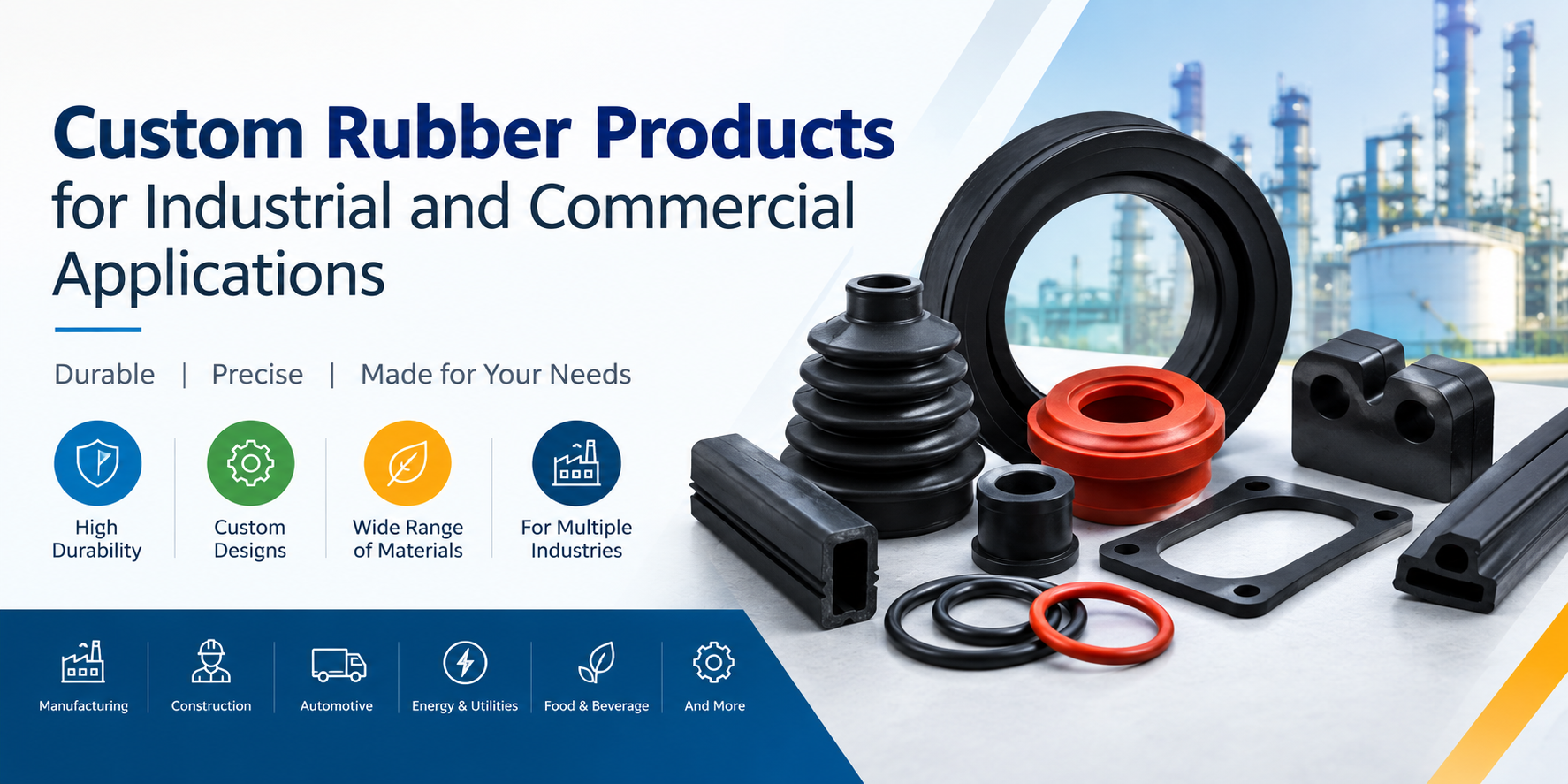
Rubber products support core functions across every major industrial, commercial, and consumer sector. They power moving machine parts, protect sensitive equipment, and seal critical gaps against dust and moisture. Most operational systems cannot run reliably without parts built to exact, unique specifications.
Silicone rubber stands out from other formulations for unmatched heat, chemical, and weather resistance. custom rubber products from Custom Silicone Rubber Molds deliver tailored solutions for every unique project need. This guide covers common types, material properties, use cases, and core benefits of these components.
The first iteration of custom rubber products gets tested against all performance requirements before full production begins. The engineers adjust design specifications to eliminate small flaws that would impact long-term part performance.
What Are Custom Rubber Products?
These molded parts match exact dimensional and performance specifications for a specific use case. The full range includes gaskets, seals, grommets, tubing, mats, and precision molded component parts. Every design follows exact industry drawings and CAD files submitted for each individual project.
Every dimension and material property aligns with unique size, shape, and performance requirements. Molded rubber products cover a huge range of use cases across every major industry operating today. They fit very specific application requirements.
A second category of molded rubber products includes low-volume prototype parts for new product development cycles. These parts get produced quickly to validate design fit and function before full-scale manufacturing.
● Static and dynamic seals for industrial machinery and processing equipment
● These parts create an airtight barrier between moving components to prevent leakage
● They resist constant friction and temperature fluctuation over thousands of operational cycles
● Gaskets for enclosures, piping connections, and mechanical assembly joints
● Insulation boots and covers for electrical and wiring assemblies
● Custom-shaped pads and mats for vibration reduction and surface protection
Why Does Industry Prefer Silicone Rubber?
Silicone rubber maintains consistent performance at continuous operating temperatures up to 400°F and higher. It delivers strong resistance to UV exposure, ozone degradation, and long-term outdoor weathering.
The material stays non-reactive when exposed to a wide range of common industrial chemicals. Food- and medical-grade formulations meet all FDA requirements for direct contact with consumable goods.
It stays flexible and durable even under constant repeated mechanical stress over long operational lifespans. It also retains its shape and dimensional stability even after years of continuous compression and movement.
Types of Custom Rubber Products We Manufacture
The full production catalog covers every common part type used across industrial, commercial, and consumer applications.
● Industrial gaskets and seals for processing, manufacturing, and heavy equipment
● Silicone molds for resin casting, art production and product prototyping work
● Rubber grommets and bushings for wiring pass-throughs and component mounting
● Custom extruded tubing and hoses for fluid and air transfer applications
● Protective rubber covers and surface mats for equipment and workstations
● Precision O-rings for hydraulic, pneumatic, and mechanical system assemblies
rubber molded parts are produced using either compression, injection, or transfer molding processes matched to part design. The selected production method depends on part complexity, required volume, and tolerance requirements.
A second line of rubber molded parts includes prototype units for design validation and testing. These units get shipped within a short turnaround window to keep project timelines on track.
What Makes Silicone Rubber Different From Natural Rubber?
Silicone is a fully synthetic material, while natural rubber comes from organic plant-based sources. It delivers far better temperature tolerance than natural rubber across both high and low operating ranges.
It is far less prone to permanent aging, surface cracking, and material breakdown over time. It carries natural hypoallergenic properties that make it safe for direct skin and food contact.
It delivers two to three times longer overall lifespan under harsh operational and environmental conditions. Natural rubber breaks down quickly when exposed to UV light, ozone, and most common industrial chemicals.
It also loses flexibility and becomes brittle at temperatures below 32 degrees Fahrenheit. Silicone maintains all its core performance properties across a far wider operational temperature range.
Key Properties To Consider In Industrial Rubber
Every project requires careful review of core material properties before final part design is finalized. The engineers match each property to the specific conditions the part will face during regular operation.
● Hardness measured on the standard Shore A scale to match required flexibility
● Hardness ranges from very soft 20A formulations up to rigid 90A dense rubber grades
● Selection depends on required compression, seal strength, and abrasion resistance
● Tensile strength rating to confirm resistance to stretching and breaking under load
● Compression set resistance to confirm parts retain shape under constant long-term pressure
● Chemical compatibility rating to confirm stability with all fluids the part will contact
● Electrical insulation properties for parts intended for use in electrical system assemblies
A reputable custom rubber components supplier provides full test data for every material grade offered. This data includes third-party test results for all performance and compliance-related properties.
A full list of custom rubber components specifications gets shared with clients for review before any production. No material gets approved for use until all requirements align with stated project needs.
Why Choose Custom Rubber Silicone Molds As Your Manufacturer?
Custom Rubber Silicone Molds carry decades of experience across every segment of rubber molding and production. They maintain full in-house tooling and design support to eliminate third-party delays. This rubber molded products manufacturer also provides formal timeline estimates that stay consistent for every confirmed order.
They offer a wide range of silicone grades matched to every possible industrial, commercial, and medical use case. They work with small startup businesses and large industrial operators on equal footing.
Their entire operational model focuses on consistent precision, batch-to-batch consistency, and long-term part durability. They do not cut corners on material quality or process control to offer artificially low pricing. All production runs go through multiple inspection stages to confirm full alignment with design requirements.
A leading rubber molded products manufacturer maintains fully transparent pricing for all project types. They provide formal quotes within 48 hours of receiving a full set of design files and requirements. Every quote breaks down tooling, production, and shipping costs separately for full clarity. They communicate immediately if any unforeseen issue impacts project delivery for any reason.
The final batch of custom rubber products goes through a full final inspection before packing and shipment. They test all parts for dimensional accuracy, material consistency, and surface finish quality. They also include a sample part from every production run for client validation on request.
Conclusion
Custom rubber products solve unique operational problems across every industrial and commercial sector. Silicone rubber delivers unmatched durability, flexibility, and safety for even the harshest use cases.
The right manufacturing partner ensures consistent precision, reliability, and long-term part performance. Custom Silicone Rubber Molds brings decades of hands-on expertise to every individual project. Clients can explore tailored rubber solutions for any upcoming application by reaching out.