Digital advertising gives businesses access to valuable information about customer behavior, campaign performance, and marketing expenditure. Yet collecting data is only the first step. The real challenge is understanding what those numbers mean and deciding how to use them to improve results.
Marketing teams frequently manage campaigns across several advertising platforms, each with its own reporting dashboard and performance metrics. Reviewing these reports manually can consume valuable time, particularly when teams need to compare campaigns, investigate changes, and prepare performance updates.
AI-powered advertising analytics is helping marketers approach this challenge differently. By making campaign data easier to explore and interpret, modern analytics solutions can support faster investigations, clearer reporting, and more informed marketing decisions.
Why Advertising Data Can Be Difficult to Interpret
A digital advertising campaign can generate impressions, clicks, conversions, engagement, and spending data. Each metric offers a different perspective on performance, but none tells the complete story on its own.
For example, an advertisement may receive thousands of clicks without generating enough purchases to justify its cost. Another campaign might attract fewer visitors but produce more qualified leads.
Marketers need to understand these differences before deciding whether to change targeting, revise creative assets, adjust budgets, or investigate the conversion process.
The challenge becomes more complicated when data is distributed across multiple platforms. Different attribution windows, reporting definitions, and tracking configurations can make direct comparisons misleading.
A reliable analysis process therefore begins with clear objectives, accurate tracking, and an understanding of how each metric relates to the business goal.
What Is an Advertising Analytics Tool?
An advertising analytics tool helps marketers examine campaign information, measure results, and identify patterns that may require attention.
Depending on its capabilities, a tool may provide campaign dashboards, performance comparisons, automated reports, visualizations, or recommendations based on available data.
AI-powered solutions add another layer by allowing users to ask questions in natural language instead of manually searching through multiple reports. This can make campaign information easier to explore for marketers who do not work with spreadsheets or analytics systems every day.
For example, a marketer might want to identify campaigns with rising acquisition costs, compare spending across reporting periods, or investigate which campaigns generated the most recorded conversions.
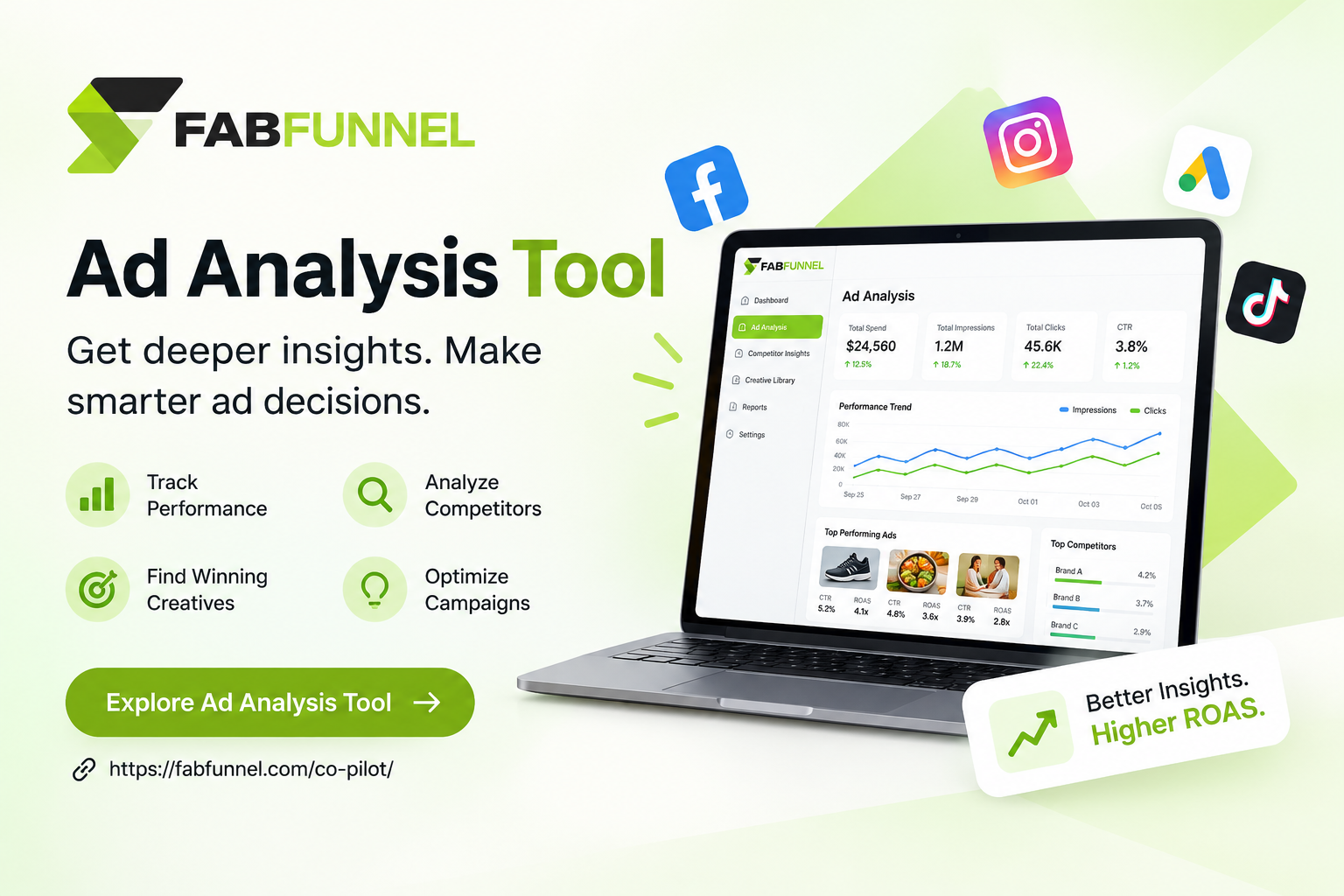
An ad analysis tool such as FabFunnel Co-Pilot helps users explore connected advertising data through natural-language questions, charts, tables, and performance recommendations. Its supported integrations include Meta, TikTok, and NewsBreak advertising accounts.
The usefulness of these insights depends on the data available, the questions asked, and the quality of the underlying tracking.
Five Ways Better Analysis Can Support Campaign Decisions
1. Identify Changes in Campaign Performance
Performance can change because of audience behavior, competition, creative fatigue, budget adjustments, or other factors.
Regular analysis helps marketers notice meaningful changes and investigate possible explanations. For example, an increase in cost per acquisition may justify reviewing audience segments, conversion rates, and changes in campaign spending.
A change in one metric should not automatically trigger a campaign adjustment. Marketers should consider the reporting period, conversion volume, and other relevant indicators before drawing conclusions.
2. Understand the Relationship Between Clicks and Conversions
High click volume does not necessarily translate into business results.
Suppose a campaign attracts considerable traffic but generates very few purchases. The problem may involve the landing page, pricing, offer, audience relevance, or conversion tracking.
Comparing click-through rates with conversion rates and acquisition costs can help teams identify where further investigation is needed.
This approach encourages marketers to evaluate the entire customer journey rather than optimizing advertisements for clicks alone.
3. Make Budget Reviews More Informed
Advertising budgets should be evaluated against business objectives and acceptable acquisition costs.
If one campaign consistently generates qualified conversions within the target cost range, a marketer may investigate whether additional investment is justified. Conversely, campaigns with weak results may require further testing before receiving more budget.
However, past performance does not guarantee future results. Audience saturation, competition, and changing conversion rates can affect outcomes when spending increases.
Analytics can inform budget discussions, but marketers should review the evidence and retain control over spending decisions.
4. Improve Reporting Efficiency
Preparing reports manually often involves collecting figures, comparing periods, creating charts, and explaining changes to stakeholders.
Tools that simplify data exploration can reduce repetitive work and make it easier to answer follow-up questions. Instead of preparing a new spreadsheet for every question, marketers may be able to investigate available data through conversational queries and visual reports.
The time saved can be redirected toward strategy, creative testing, audience research, and campaign planning.
5. Support More Structured Experiments
Marketing teams often test different headlines, creative formats, audiences, and offers. Without a clear measurement plan, however, it can be difficult to determine whether a change actually improved performance.
Before launching a test, define the objective, primary metric, test duration, and conditions for evaluating success.
Once the test has collected sufficient data, compare the results while accounting for factors such as audience overlap, external events, and differences in campaign delivery.
Analytics can help organize these comparisons, but sound experimental design remains essential.
How to Choose the Right Analytics Solution
Not every business needs the same capabilities. Before adopting an advertising analytics platform, consider the following factors:
Platform compatibility: Confirm that the solution supports the advertising accounts your team uses.
Relevant metrics: Ensure it can help examine the indicators connected to your campaign objectives.
Clear reporting: Look for understandable visualizations and useful comparisons across reporting periods.
Data quality: Check whether tracking gaps, attribution differences, or missing information could affect conclusions.
Transparency: Prefer recommendations that can be examined against the underlying metrics.
Access and privacy: Review account permissions, data handling, and organizational security requirements.
A tool should solve a genuine workflow problem rather than add another system that requires extensive manual maintenance.
It is also important to distinguish recommendations from automated execution. Some products analyze data and suggest actions, while others can make campaign changes. Marketers should understand which capabilities a specific solution provides before relying on it.
The Importance of Human Judgment
AI can help marketers explore data more efficiently, but it should not replace critical thinking.
A sudden drop in conversions might reflect a genuine campaign problem, a website outage, delayed reporting, or a tracking error. Acting on an incomplete interpretation could lead to unnecessary changes.
Teams should verify unusual findings, consider alternative explanations, and assess recommendations against their business objectives. Important decisions involving substantial budgets deserve particular care.
Combining analytical tools with human expertise creates a more balanced process: technology helps surface patterns, while marketers provide context and decide what action is appropriate.
Conclusion
Advertising analytics is becoming an important part of modern campaign management because it helps businesses move beyond collecting numbers toward understanding performance.
AI-powered solutions can make campaign data easier to explore, streamline reporting, and help marketers identify questions that deserve further investigation. Their value is greatest when supported by accurate tracking, clear objectives, and a disciplined approach to testing.
By choosing appropriate tools and reviewing recommendations carefully, marketing teams can make more informed decisions about campaign optimization, budget allocation, and future experiments.
The goal is not to automate every marketing decision. It is to make better use of available evidence and build a more consistent process for improving advertising performance over time.