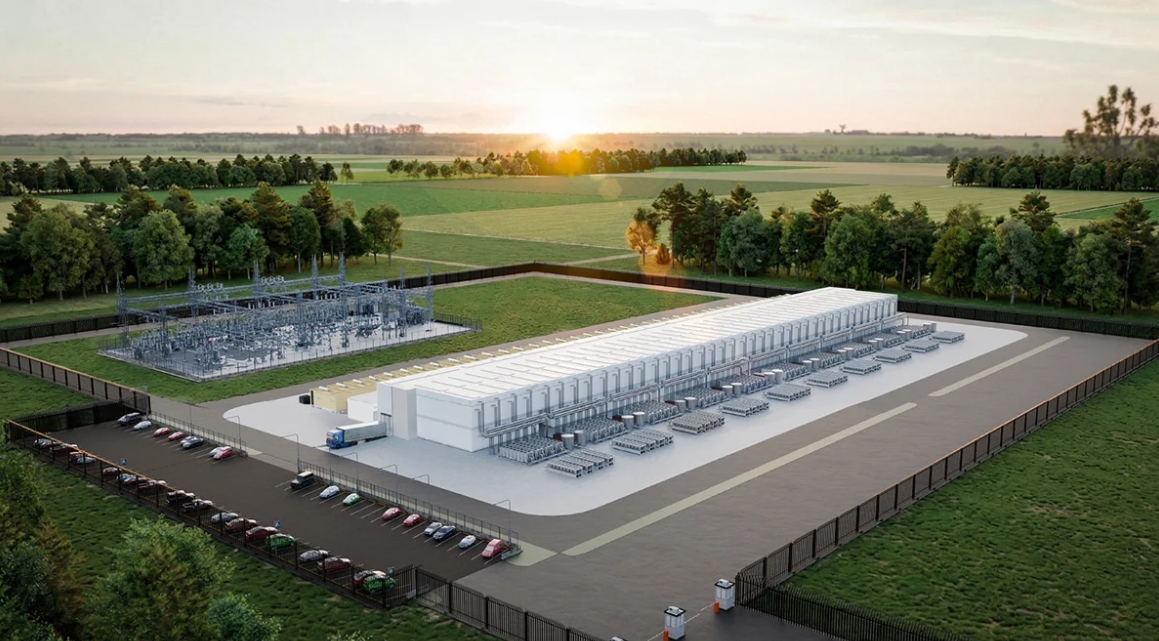
AI has already reshaped what happens inside a single data hall; now it is rewriting how entire data center campuses are conceived, financed, and operated. In the AI era, the constraint is no longer just how much density you can pack into one room, but how whole sites and portfolios keep up with a six- to-twelve-month compute refresh cycle without tearing up the infrastructure every time.
FROM AI DATA HALL TO AI CAMPUS
AI has flipped the traditional ratio between white space and MEP, pushing average rack densities into the 150-200kW range, with pockets far beyond that. This inversion has forced operators to rethink the engineered performance layer inside the hall, shifting from generalized space to highly specialized environments tuned for thermal and electrical performance.
At campus scale, the challenge is to synchronize long‑lived power and cooling assets with short‑lived AI hardware generations, each with its own density, cooling profile, and interconnect topology. An increasingly important approach is to fix and standardize the power and cooling backbone, while flexing the white space as a set of interchangeable modules that can be deployed as a seamless, connected, and controlled environment.
FIX THE PLANT, FLEX THE WHITE SPACE
In this “fixed-support, modular-IT” paradigm, operators deliberately separate long‑life utility systems from short‑life AI modules. Substations, medium‑voltage distribution, primary cooling plants, and utility spines are engineered for decades of service, while racks, manifolds, distribution skids, and modular white space blocks are designed for more aggressive refresh and replacement cycles.