Introduction
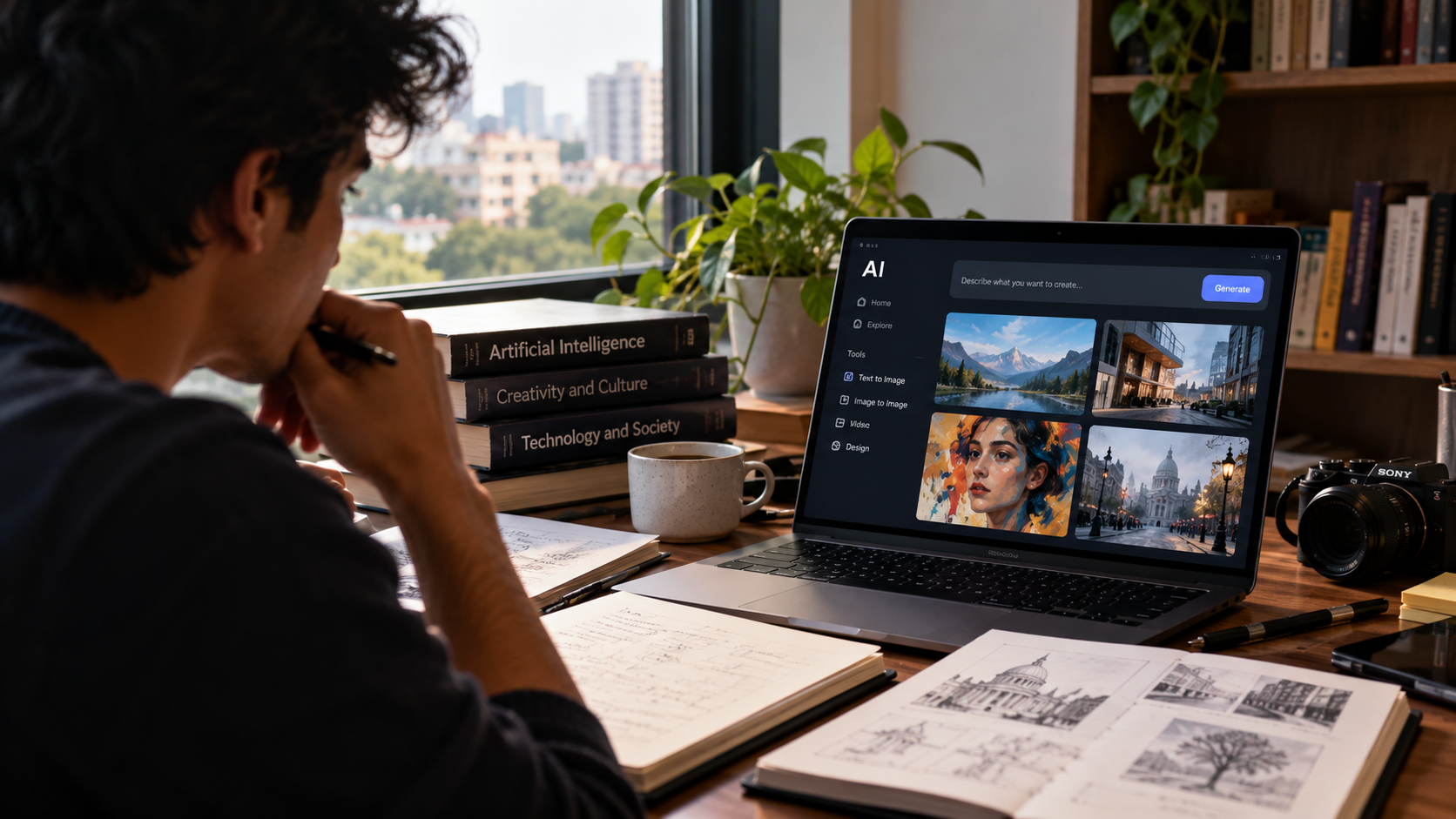
Artificial intelligence has moved rapidly from being a specialised technological field to becoming part of everyday creative life. Tools powered by AI can now generate images, write text, produce music, assist with design and help creators develop ideas within seconds. What once required specialised technical skills, expensive software or hours of manual work can increasingly be supported by a machine.
This transformation has created a new question: if a machine can generate something creative, what exactly makes human creativity different?
The debate is no longer limited to whether artificial intelligence can produce convincing content. It is increasingly about how humans should work with these systems, where creative responsibility lies, and whether AI will replace creative workers or instead become another powerful instrument in the creative process.
From Automation to Creative Collaboration
Earlier generations of digital technology largely focused on making existing creative processes faster and more efficient. Artificial intelligence has introduced something different: systems that can participate directly in the generation of content.
A writer can use AI to brainstorm ideas, structure an article or explore alternative ways of presenting an argument. A designer can generate visual concepts before developing a final composition. Artists can experiment with styles and compositions that might otherwise take considerable time to produce.
This has shifted the relationship between humans and technology.
AI does not necessarily have to function as a replacement for the creator. It can also act as a creative collaborator—a system that generates possibilities while the human decides which possibilities are meaningful, appropriate or worth developing.
The distinction is important because creativity is not simply the production of an image, sentence or piece of music. Human creativity also involves intention, context, experience, cultural understanding and judgment.
Can AI Really Be Creative?
The ability of AI systems to produce apparently original material has intensified the debate over whether machines themselves can be considered creative.
An AI model can combine patterns learned from enormous quantities of existing material and generate something that may appear new. Yet the system does not experience the world in the same way a human creator does. It does not possess childhood memories, personal relationships, cultural experiences or an individual emotional history.
For this reason, some researchers and creators distinguish between generating content and experiencing creativity.
A machine may produce an unexpected combination of words, colours or sounds. But the human being interpreting that output can give it meaning, connect it to a social context and decide why it matters.
This makes human judgment increasingly important rather than irrelevant.
The Changing Role of the Creator
As AI tools become more capable, the role of creative professionals is likely to change.
The creator of the future may spend less time performing repetitive production tasks and more time developing concepts, evaluating outputs, refining ideas and making decisions. In this environment, knowing how to communicate with AI systems, evaluate their outputs and identify their limitations can become an important creative skill.
This does not mean that traditional creative abilities will disappear.
Writing, visual composition, research, storytelling and critical thinking remain essential because AI-generated material still requires direction and evaluation. A person who understands a subject deeply can recognise inaccuracies, improve weak ideas and provide a coherent purpose that an automated system may not independently establish.
In other words, AI may change the tools of creativity without eliminating the need for creative judgment.
Creativity, Culture and Human Expression
The impact of AI extends beyond professional creative industries. It is also changing how ordinary people express themselves.
Someone without formal training in graphic design can now create sophisticated visual concepts. A person learning to write can use AI as a brainstorming partner. Students can explore complex subjects through interactive systems. Small organisations can produce communication materials that previously required specialised services.
This democratisation of creative tools could expand participation in cultural and creative activities.
At the same time, it raises questions about originality, authorship and cultural representation. If AI systems are trained on enormous collections of human-created material, questions naturally emerge about how existing creative work contributes to machine-generated outputs.
These questions will become increasingly important as AI-generated content becomes more common.
The Question of Human Value
The rise of generative AI does not necessarily make human creativity less valuable. In some respects, it may make uniquely human qualities more visible.
When machines can generate thousands of possible ideas almost instantly, selection becomes as important as generation.
A human creator still has to decide what deserves attention, what communicates a particular experience and what should be rejected. Human beings also create within relationships, communities and cultures. A creative work can carry personal memory, political meaning, social experience or cultural identity.
Those dimensions cannot be reduced simply to the ability to generate content.
The future of creativity may therefore be less about choosing between humans and machines and more about understanding how the two can interact.
A New Creative Landscape
Artificial intelligence is already changing the boundaries of creative work. The question is no longer whether AI will influence artists, writers, designers and researchers—it is how deeply that influence will reshape their work.
Some creative tasks will become automated. Others will become faster. New forms of collaboration will emerge, while entirely new creative professions may develop around AI-assisted production.
The most significant change may ultimately be conceptual.
For centuries, creativity was often associated with the ability to produce something original through human skill and imagination. AI challenges that assumption by making machine-generated content increasingly accessible.
Yet the emergence of AI does not automatically make human creativity obsolete.
Instead, it forces society to reconsider what creativity actually means.
Conclusion
Artificial intelligence is changing creative work, but the future is unlikely to be defined simply by machines replacing humans. A more complex relationship is emerging—one in which technology can generate possibilities while humans provide intention, judgment, context and meaning.
The real challenge is therefore not to determine whether AI can create exactly like a human. It is to understand what humans should continue to create, what machines should help create, and how both can work together without losing the value of human expression.
As artificial intelligence becomes increasingly embedded in art, writing, design and culture, creativity itself may be entering a new phase—one where the most important skill is not merely the ability to create, but the ability to decide what is worth creating.
— Aniruddha Adhikari